
Classic 13-card rummy
OK Rummy App – Lobby, Wallet and File Record
This record covers OK Rummy, a Classic 13-card rummy client. People reach it through queries such as “ok rummy rules”, “ok rummy yono” and “ok rummy yono 777”; the sections below answer in that order. Nothing here is an offer or a route to stake money.
File facts
- Format family
- Classic 13-card rummy
- Format variant
- Rummy plus arcade grid
- Wallet structure
- Separate bonus wallet (category pattern)
- Stated minimum payout
- ₹100 † (category)
Screenshots


Points, pool and deals: what the lobby actually lists
Thirteen cards, a closed deck and a meld requirement: that is the base format. The interface adds a sort control, a joker marker and a drop button, and the rules panel explains how each is scored. Nothing in the structure requires a cashier, which is why a practice table can run the same engine.
A sequence is three or more consecutive cards of the same suit; a pure sequence uses no joker. In the 13-card format a declaration normally needs at least two sequences, one of them pure, and the rest can be sets. A hand with three sets and no pure sequence is not a valid declaration, however strong it looks.
The table list is organised by format and entry band, with a practice section that does not touch the cashier. Sorting is by activity or stake, and the filter persists between sessions. The lobby is where the format decision is made, before any card is dealt.
The bonus wallet, the cash wallet and the gap between them
Two balances normally appear after the first credit: a withdrawable balance and a bonus wallet. They sit on the same screen and fund the same lobby, but only the first is treated as money the cashier will release. Most of what follows in this section comes from that split.
Credit surfaces in this category follow a small set: mobile OTP binding, check-in streaks, VIP rebates and referral codes. Each usually carries an unadvertised release condition, and no figure should be read as a promise.
Withdrawal usually requires identity verification: a PAN or Aadhaar reference, a name that matches the bank account, and sometimes a selfie. The name on the app account, the name on the bank account and the name in the KYC record have to agree, or the payout stalls.
Bonus abuse controls are the least visible part of the wallet. Device identifiers, installed-app lists and payment metadata are combined to spot linked accounts; when the rule trips, the usual outcome is a hold on all balances instead of a warning.
- Turnover multiple: the credit has to be cycled before any part of it is released.
- Expiry window: credit lapses on a date, after inactivity, or when a campaign ends.
- KYC name match: profile, identity record and bank account have to agree.
- One account per device: linked accounts can freeze every balance on the device.
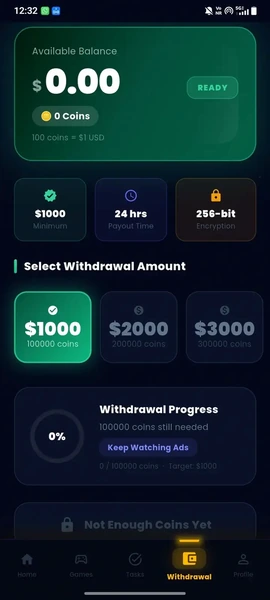
Withdraw tab: destination fields and the review states
The cashier divides into funding and payout. Funding is where a payment is authorised; payout is where a balance is requested back. The two share a header and little else, and only the payout side is documented here.
UPI payout is addressed by VPA, the short name@handle identifier. The withdraw tab checks the shape of the string, not whether the handle belongs to the account holder. A wrong handle can send a payout to an unrelated wallet, and recovery depends on the receiving bank.
Statements are where payout terms become checkable. Without one, a user cannot prove what was requested or what was deducted. This record notes whether a statement surface is described in the listing; most listings do not mention one at all.
- Requested: the amount is accepted and placed in the queue.
- Processing: transfer started or review open; the label does not say which.
- Under Review: a manual check is holding the request.
- Paid / Rejected: final states; a rejection should carry a reason code.
One family, many packages: how to tell variants apart
“Yono” is a naming family instead of a single product. Builds carrying the name share a lobby style and a wallet pattern, but they are separate packages published by separate entities. A search for one variant often surfaces another.
Search demand for a family term is often larger than demand for any single variant. That is why a page about one build has to explain the family: a reader arriving from a family query needs to know which package they are actually looking at before anything else.
Rules and scoring: the parts the lobby does not explain
The declare button is a submission to a validator. It checks meld validity, the pure sequence and the joker usage. Because the check is mechanical, a visually tidy hand can still be rejected, and the penalty is applied immediately.